


Insulated glass refers to two sides of glass, separated by aluminum strips in the middle, in the aluminum strip some desiccant. Although there is some air inside, it is completely separated from the outside world. Vacuum glass is a kind of deep-processed high-performance glass, which is developed based on the principle of thermos bottle. Generally, at least one piece is a low-radiation glass, so that the heat lost through the conduction, convection and radiation of the vacuum glass is minimized. You can see the difference by definition, there is air in the hollow, there is no vacuum.
The following points can be used as a reference to measure the gap between them:
1. Sound insulation performance.
As we all know, the transmission of sound requires the participation of a medium. Sound cannot travel in a vacuum without a medium. The sound insulation and noise reduction performance of vacuum glass is based on this principle. It can effectively block the transmission of sound. The propagation of vacuum glass sound is mainly achieved through solid propagation of glass panels, supports and surrounding seals.
2. The thickness of glass.
Vacuum glass is easier to achieve the desired sound insulation and thermal insulation properties with a smaller thickness. In order to achieve the same sound insulation and thermal insulation properties, the thickness of the glass has been reduced. This reduce the cost of storage and transportation.
3. Heat insulation.
Due to the different structure, the heat transfer mechanism of insulated glass and vacuum glass is also different. Heat transfer in the central part of the vacuum glass is composed of radiation heat transfer and support heat transfer (ignoring residual gas heat transfer). The insulating glass is composed of gas heat transfer (including conduction and convection) and radiation heat transfer. Therefore, to reduce the heat transfer caused by temperature difference, both insulating glass and vacuum glass need to reduce radiation heat transfer, and the most effective method is to use low radiation coated glass (LowE glass).
4. Impact resistance.
The impact resistance of insulated glass is relatively good. Its internal air can play a certain buffer role to reduce the impact of external impact on the glass; Due to its internal vacuum state, vacuum glass is not easy to disperse when receiving external impact and is easy to break when absorbing impact force, so the impact resistance is not as good as that of insulating glass, even several times the difference.
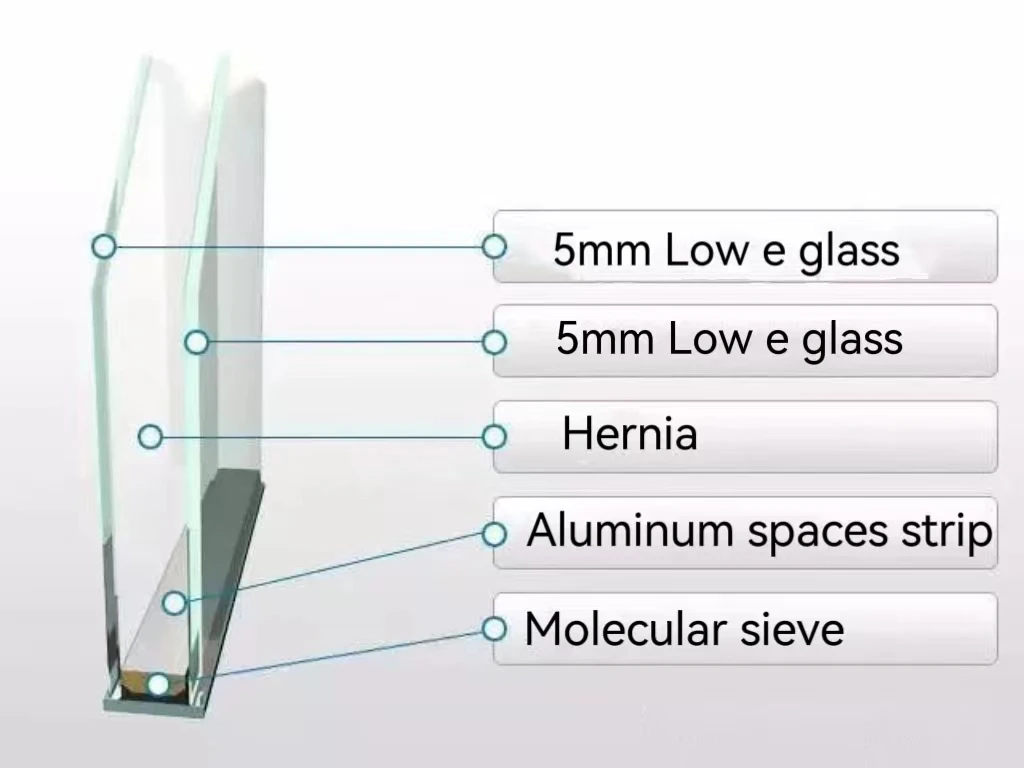
In summary, vacuum glass has significant advantages in heat insulation, heat preservation, sound insulation, etc., but the wind pressure resistance and impact resistance are weak. For the structural design of doors and Windows, the depth of the installation hole and other factors, using vacuum glass alone is not necessarily the best choice. And the cost of vacuum glass is 3-4 times that of ordinary insulating glass, which is also one of the conditions unacceptable to the general public, so vacuum glass is generally used in laboratories, hospitals, troops and other special places. Insulated glass has a relatively low cost and better performance, especially in impact resistance, but the thermal insulation, thermal insulation and sound insulation performance is not as good as vacuum glass.