


Block glass is an essential structural material in people's daily lives, as it can separate the internal and external environment while transmitting light. However, the thermal insulation performance of glass is poor, and it is prone to catastrophic breakage under impact, resulting in limited impact resistance and energy consumption. Under external temperature changes and debris impacts, glass often becomes the weakest component in buildings, transportation vehicles, and electronic devices.
Recently, a research team led by Professor Ni Yong and Professor He Linghui from the University of Science and Technology of China proposed a biomimetic composite glass material with improved comprehensive application performance, combining a shell like pearl layer structure and shear hardening intelligent material. This composite glass material exhibits excellent thermal insulation and impact resistance while maintaining transparency. The relevant research results were published in the international journal Advanced Materials under the title "Simultaneous Enhancement of Thermal Insulation and Impact Resistance in Transparent Bulk Compounds".

The pearl layer in natural shells can dissipate energy through the brick sliding mechanism under quasi-static or low-speed impact loading. However, as the impact speed increases, the improvement in the impact resistance of the shell like structure is limited (Figure 1a). On the contrary, shear hardening materials exhibit strain rate related enhancement effects under impact loading, which can dissipate a large amount of impact kinetic energy under high-speed impact (Figure 1b). On the basis of a deep understanding of the rate related mechanical properties of shell like structures and shear hardening materials, the research team constructed biomimetic composite glass materials. This material combines the advantages of low-speed impact resistance of the shell like structure with the strain rate strengthening performance of the shear hardening material. Mechanical simulation analysis shows that the delocalized deformation of the shell like structure panel can further promote the large-scale damage and energy dissipation of the shear hardening sandwich layer. The synergistic energy dissipation effect of shell like structure and shear hardening material shows a 1+1>2 effect, which makes the composite glass exhibit better impact resistance performance at a larger range of impact speeds (Figure 2).
In addition, biomimetic composite glass also exhibits good thermal insulation performance. The biomimetic shell structure panel reduces out of plane heat conduction through a special brick mortar layout structure, and works together with low thermal conductivity shear hardening materials to improve the thermal insulation performance of biomimetic composite glass. Compared with the widely used block glass, laminated glass, and insulating glass, biomimetic composite glass shows advantages in comprehensive application performance such as transparency, lightweight, impact resistance, and thermal insulation (Figure 1c).

Figure 1
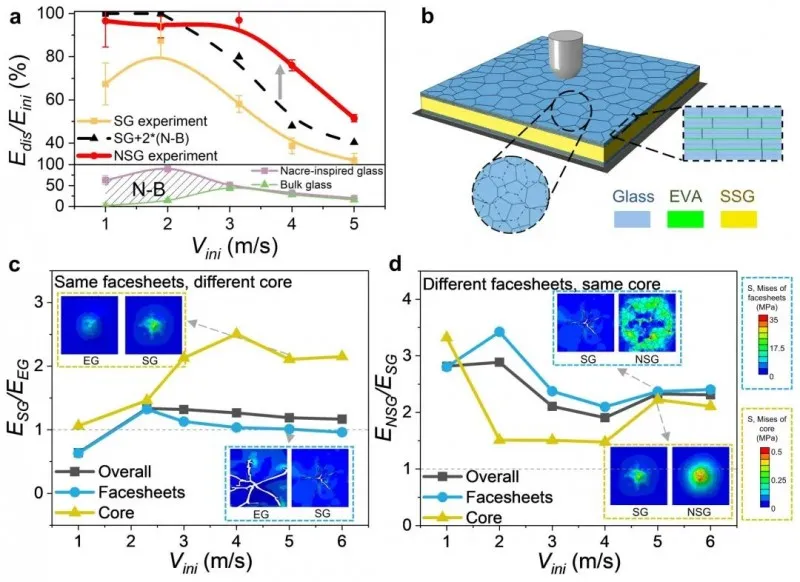
Figure 2